Orchestral interpretations of prog

Updated: Aug 4

Summer in the UK marks a season of promenade concerts, based at the Royal Albert Hall, but in recent years with events taking place at other venues around the country. Primarily a showpiece for classical music, the first rock band invited to perform was Soft Machine, with a set comprised of Facelift, Esther’s Nose Job and Out-Bloody-Rageous; the first ‘pop prom’, on August 13th 1970.
I’ve now lived in London for 50 years, but put off by audience displays of over-the-top patriotism on the last night of the proms each year, have attended just two of the events, an evening centred around Holst’s The Planets in 2022, and this year’s Prog Rock: A Fanfare for the Common Man, a celebration of ‘the pioneering, British-driven movement in a concert featuring classic tracks on an orchestral scale, with brand new arrangements…’
I attended a number of concerts by the Northern Sinfonia when they visited my corner of the north west of England during the 70s, my interest in European art music derived from listening to works by The Nice and Emerson Lake & Palmer. Symphonic prog was the first progressive rock sub-genre I was exposed to, whether in the form of electronic instruments including Mellotron and synthesizers used in arrangements to emulate the timbral range of an orchestra by groups such as Yes, Refugee, Trace and The Enid, or listening to a group with orchestra (in roughly the order of discovery): The Nice, Pink Floyd, Continuum, The Moody Blues, Procol Harum and Fruupp. I maintain that the best integrated orchestration of music by a rock group is David Bedford’s score for Camel’s Music Inspired by the Snow Goose and my least favourite is probably Days of Future Passed, due to how badly it has aged.
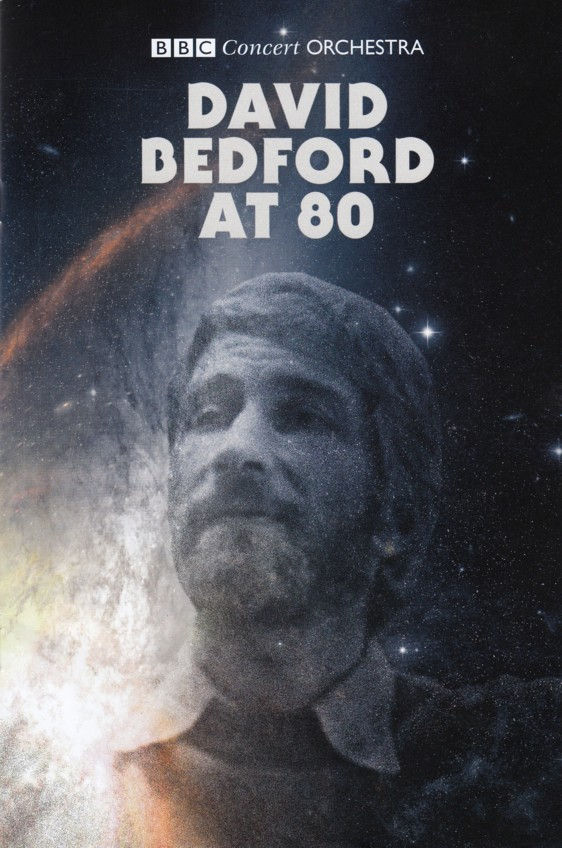
It’s coming up to what would have been Bedford’s 89th birthday, and back in 2018 I attended a posthumous concert billed as ‘David Bedford at 80’, which included a presentation of his full score of Mike Oldfield’s Tubular Bells played by the BBC Concert Orchestra, conducted by Michael Seal. The venue, the Queen Elizabeth Hall on London’s South Bank, had hosted a promotional gig for Tubular Bells a month after its release in 1973 where Bedford played keyboards in the ensemble alongside Oldfield and a cast of musicians associated with Virgin Records, including John Greaves and Fred Frith of Henry Cow and Steve Hillage from Gong. Bedford would subsequently record The Orchestral Tubular Bells with the Royal Philharmonic Orchestra (and Mike Oldfield on acoustic guitar) at Barking Town Hall in September 1974.
With a prime seat in the third row and a good view of the 60-strong orchestra’s organisation, I found myself able to discern how the piece had been scored, how to discriminate the lines of the different groups of instrument and how the overall composition fitted together, and was also able to visualise how Bedford had so successfully blended Camel’s melodic progressive rock with the London Symphony Orchestra which I now see has his stamp all over it. I hadn’t listened to The Orchestral Tubular Bells album since around the time of its release, but had to agree with the notion that if you hadn’t heard Oldfield’s solo effort, the music could well have been a modern classical composition. One of the very few weak spots on the original, as much for the stomping rhythm as the vocals, is the ‘Piltdown Man’ section on side two, a reaction to the perceived belief it was necessary to have singing on an album, but that worked so much better with the orchestra.
The David Bedford concert wasn’t the first time I’d heard orchestral arrangements of prog. The Yessymphonic tour of 2001 didn’t simply rely on material from the just-released Magnification, written for group and orchestra, but included new arrangements of Yes classics, where local orchestras were commissioned to play the music written by film composer and conductor Larry Groupé.
In 2012 I went to see Jon Anderson and Miro Zbrika with the Slovak Symphony Orchestra at Sadler’s Wells. Anderson presented the second set, comprised of arrangements of his solo work, Jon and Vangelis material, and Yes classics. He opened with perennial favourite Starship Trooper which, along with the other Yes material -
a brilliant but truncated version of Long Distance Runaround featuring some nice orchestral counterpoint, the Nous Sommes du Soleil coda to Ritual, disguised with a short but stunning orchestral prelude, and a shortened version of And You and I, really suited the orchestral arrangements. While some of his other choices fell a bit flat, final song State of Independence had also withstood the test of time… and cover versions.

Although the Royal Philharmonic Orchestra had produced a studio album of Rick Wakeman’s earliest solo works in 1978, the first time I noticed what seemed like a sudden glut of orchestral interpretations of music by classic prog bands was the 1993 album Symphonic Music of Yes, put together by Dee Palmer with members of the band, the London Philharmonic Orchestra and the English Chamber Orchestra, and this wasn’t the first of Palmer’s forays into the field. A symphonic album of Jethro Tull songs was released in 1985, called A Classic Case, played by the London Symphony Orchestra; We Know What We Like: The Music of Genesis with the London Symphony Orchestra came out in 1987; and Objects of Fantasy: The Music of Pink Floyd, later retitled The Music of Pink Floyd: Orchestral Maneuvers was released in 1989, this time featuring The London Philharmonic.
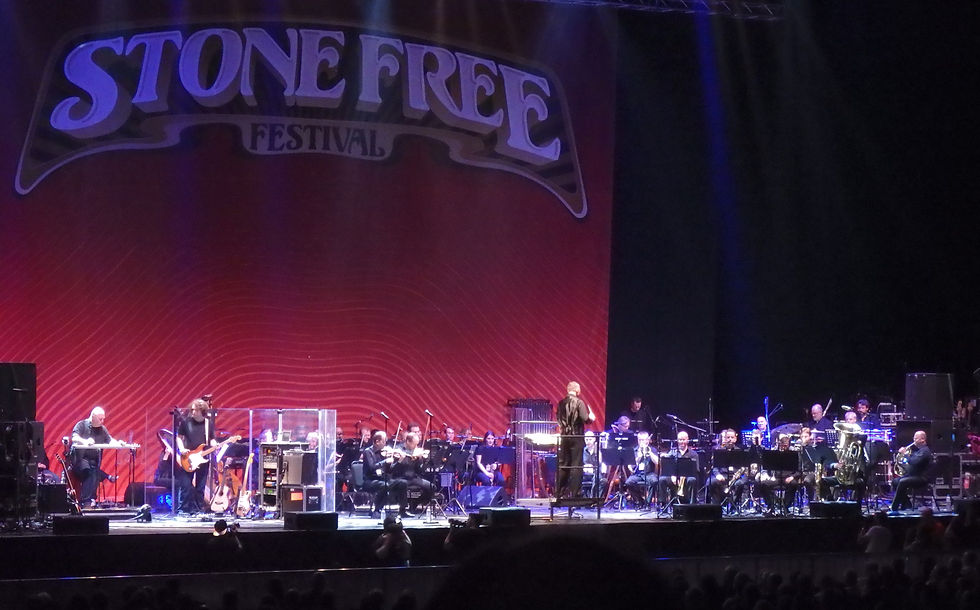
I was never tempted to buy any of these, and recently a friend told me that some of these tunes didn’t actually translate to classical pieces too well. However, I got the chance to see The Orion Orchestra performing the whole Wish You Were Here album at the 2016 Stone Free Festival. Not knowing how this might work out, I was surprised to find that I really enjoyed the performance. I liked the way that Shine on You Crazy Diamond began with tuned percussion, mimicking Rick Wright’s barely perceptible twinkling, descending arpeggio, but this piece proved to be structurally suited to orchestration and sensibly eschewed vocals, with the key changes providing some nice drama. At the time, I couldn’t work out why I was reminded of passages from Sgt Pepper’s and Days of Future Passed; was it a result of a shortage of harmonic complexity in the original composition or just the modus operandi of the individual responsible for the arrangement? Welcome to the Machine and Have a Cigar weren’t quite so successful, and the title track really didn’t convert so well to the orchestral format. The performance was concluded with a triumphant, truncated, vocal-less version of Eclipse.
I’m not entirely sure that it would have been appropriate for classical music aficionados, but the inclusion of the orchestra in the programme for a rock gig was perfectly apt, providing an alternative way for fans to experience a well-known album in a very different way, exposing subtle nuances that may have been buried in the layers of the 1975 release.
I was at the Barbican Hall in July 2015 for what turned out to be Keith Emerson’s last ever performance, playing The Three Fates Project, an album of orchestrated works by Emerson, largely but not exclusively originally presented as trio pieces with ELP. Emerson, whose love of classical music is indisputable, was joined by members of his band and the BBC Concert Orchestra with conductor Terje Mikkelsen. His long history of integrating a rock band with an orchestra dates back to his days with The Nice: The side-long title track of Ars Longa Vita Brevis (1968); the commissioned title track from Five Bridges (1970); and ELP’s Works (1978) which included his Piano Concerto no.1, the first true formal classical piece he’d written.
The show began with just the orchestra, then drummer Ralph Salmins and bassist Travis Davis building up the quiet orchestration at the start of Abaddon's Bolero. The appearance of guitarist Marc Bonilla as the number grew to a crescendo drew a burst of applause from the audience which was repeated, nuch louder, when Emerson, replete in a sparkly dark suit, appeared for a few bars on the Moog at the end of the piece. The music fitted the classical treatment really well and it was during the second piece, The Endless Enigma that I realised how Emerson’s scoring for strings was quite identifiable, harking back to The Five Bridges Suite. It was interesting to hear the performance of Alberto Ginastera’s Malambo, and the presentation of Fanfare for the Common Man, preceded by a story about asking Copeland for permission to use the piece, allowed a comparison of the score as written with a version just featuring the electric group which followed. The highlight was of course Tarkus in its entirety, which didn’t sound out of place as an orchestrated piece; the only negative was a walk=out by one of the musicians very early on in the proceedings, striding off stage never to return. It’s unclear if this was some form of protest or a health issue but it seemed deliberate, and very odd.
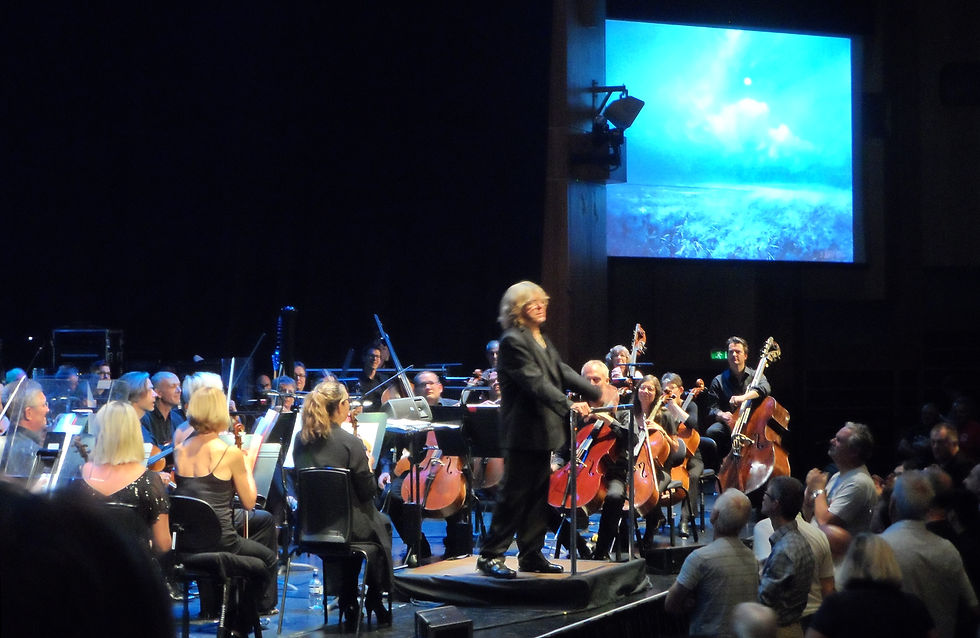
Presented by radio host and author Stuart Maconie, Prog Rock: A Fanfare for the Common Man provided the opportunity to hear a range of prog compositions arranged for an orchestra, the BBC Concert Orchestra once again, conducted by Robert Ames. An array of guests had been invited to take part, but only two were prog legends, Carl Palmer and Peter Hammill. Of the others, Jane Weaver was prog-related, Guy Garvey, who professes to be something of a prog head, has appeared in Prog magazine, and Gruff Rhys, the Staves and Vanessa Haynes didn’t appear to have anything to do with the genre.
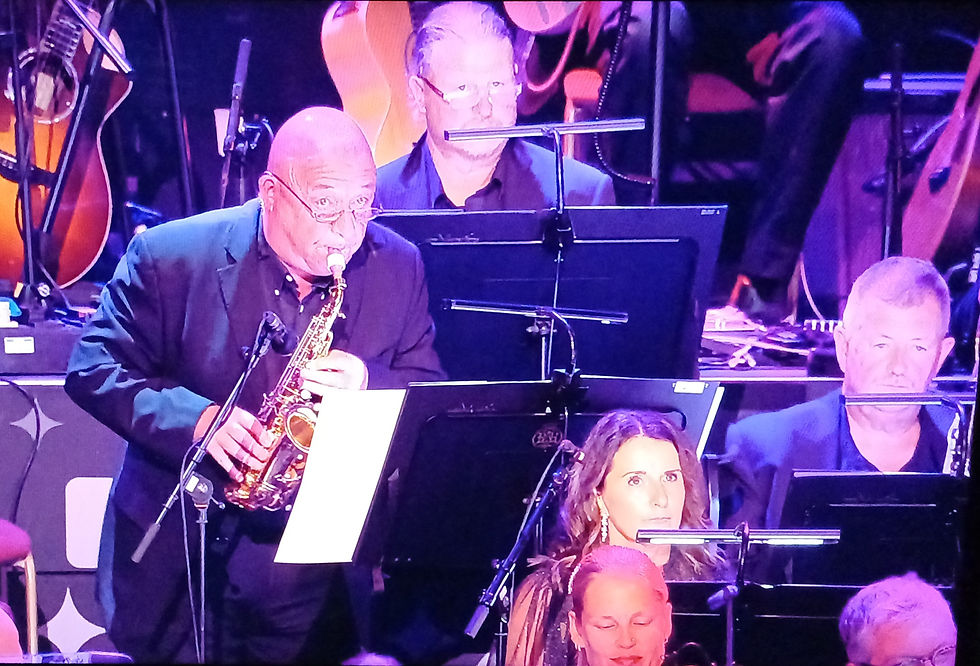
With a seat towards the front row of the stalls and almost level with the sound desk, I didn’t anticipate any problems with the mix and from my position, though it was harder to understand the instrumental arrangements, I genuinely couldn’t complain about the balance. Opening number Fanfare For The Common Man stuck to the ELP arrangement featuring Palmer on drums, and being a well known interpretation of Copland’s score, it worked very well. The flute-dominated Living In The Past didn’t fare so well, although I couldn’t fault the orchestration which easily coped with the accents of the 5/4 time signature, unlike Gruff Rhys, whose timing problems exaggerated his nerves and along with forgetting the words, he was hopelessly out of tune. The third piece, Out-Bloody-Rageous, one of the tunes played by Soft Machine in 1970, had a subtle arrangement behind an electric band and Andy Findon’s excellent sax.
Guy Garvey came on to sing I Know What I Like (In Your Wardrobe) and this provided the first example of the evening where an orchestral arrangement didn’t work. He was replaced on stage by Jane Weaver singing Northern Lights, a hit single for Renaissance in 1978 (reaching no.10 in the UK charts.) Christian Balvig can’t have had too much work to do with the arrangement because Michael Dunford’s song, like the bulk of Renaissance’s work, was an orchestrated piece. The only disappointing aspect of the performance was the drawn-out ending which made the rendition appear to exceed the 4’ 07 of the album version by some distance. Weaver remained on stage for Nights In White Satin, which also worked well. The original recording was comprised of Ray Thomas’ flute and overdubbed Mellotron parts to give it the orchestral sweep, and the London Festival Orchestra parts were mixed in towards the end to give the song the climactic ending.
My favourite piece, worth the price of admission alone, was Peter Hammill singing Refugees, written in 1969. He was looking a little frail and despite a much larger backing band than that for his day job, I thought he looked a bit isolated, but he belted out the song with unbelievable emotion, and Adam Dennis did an excellent job with the orchestration.

The Staves, an alt-folk duet of sisters Jessica and Camilla Staveley-Taylor, were on next performing And You And I. Peter Riley’s arrangement, enhanced by acoustic guitar and keyboards, was on a par with the version I’d heard in 2012 but the vocals were a little hesitant and the last number before the intermission, an awkwardly joined overture and climax of Tubular Bells where the instruments were announced by the voice of Matt Berry, didn’t work anywhere near as well as David Bedford’s score.
My first live appearance in a band was at a revue concert in 1984, where I’d requested a slot immediately after the intermission so that the compere could read out a short script I’d handed to him: “Welcome back my friends to the show that never ends. Ladies and gentlemen: BCC.” The second part of the Prog Rock: A Fanfare for the Common Man began with a very brief portion of Karn Evil 9 – First Impression Part 2 orchestrated around Greg Lake’s vocals from Brain Salad Surgery. Despite being really short, at less than two minutes, it was well done. This was followed by an unusual but effective medley of Focus’ Sylvia, Komfo by Osibisa and Peaches En Regalia by Frank Zappa, highlighting that prog bands didn’t all come from the UK. I’ve largely ignored Osibisa in the past, but perhaps I’ll now look out for their albums.
It was another medley next, with three tracks from In The Court Of The Crimson King. Garvey used a megaphone for the distorted vocal on 21st Century Schizoid Man which segued into I Talk To The Wind and then In The Court Of The Crimson King. Musically, these pieces did transcribe satisfactorily for orchestra, but I don’t think Garvey was the best choice of vocalist for the evening (Gruff Rhys certainly wasn’t, I’m afraid to say.)

Garvey remained on stage for Entangled, telling the audience he couldn’t remember a time when Genesis’ A Trick of the Tail didn’t exist, and was joined by Weaver. This worked better than I Know What I Like but it wasn’t really convincing, with two guitarists taking on a major role. On the other hand, the fully instrumental interpretation of On Reflection by Gentle Giant was immensely enjoyable, with brass to the fore.
Next came one of the odd choices for the programme. Representing the folk influence on prog, Maker Of Islands by the Incredible String Band might have been Rhys’ best performance of the evening, and it seemed to have been orchestrated quite well, but it’s genuinely not something that leaps out as one of the great prog-folk tracks and I thought it went on interminably. The Pink Floyd slot was taken up by The Great Gig In The Sky, vocalised by Vanessa Haynes. Another track that must have been imprinted into the memory of almost everyone in the audience, I was unable to even think what the orchestra were doing, with piano, spoken word backing and above all, Haynes’ magnificent voice.
The Staves were in charge of vocals for another off the wall piece, Crime Of The Century by Supertramp. While Pink Floyd’s prog credentials were questioned in the concert programme, alarmingly, Supertramp’s were not (another mistake in the programme text had keyboard player Rick Davies dying in 2005, not 2025.) I can’t say I was a fan of this tune.
The finale saw Carl Palmer return to the drum stool for ELP’s arrangement of Mussorgsky’s The Great Gate Of Kyiv, this being one of the earliest pieces of ‘rocking the classics’ I’d heard. I don’t believe the performance was perfect but it did serve as a suitably thrilling climax to the evening, and the conductor, orchestra and contributors all received a resounding display of appreciation from those present, and there was a nice moment when Palmer shook hands with Hammill during the curtain call.
I watched the performance on TV when it became available and the difference between witnessing the performances live and recorded was stark. To start with, Living In The Past was cut for the TV broadcast, presumably deemed to be of not a good enough standard, but also the broadcast mix was inferior to the live auditorium sound; yes, it was possible to hear the out of tune moments from my seat in the Hall, but the broadcast amplified the errors. If I’d been able to listen to the broadcast before attending, I’m really not sure that I would have gone.

My opinion, shared with friends, that there are prog tunes that lend themselves to orchestration and some that don’t was further borne out by the prom. I’m pleased I did go, and not only for Hammill’s heartfelt rendition of Refugees, but because it provided the opportunity to hear familiar music in an unfamiliar manner, even though it was only a partial success.


Comments